THE ELLIPTICAL ECOSYSTEM™
Everything moves together.
A business does not flow because it has more tools, more automation, or more AI. It flows when people, processes, technology, information, and intelligence are intentionally designed to work together.
The Elliptical Ecosystem™ is Be Empowered Consulting’s five-stage methodology for turning fragmented operations into a connected, human-led, AI-assisted operating environment.
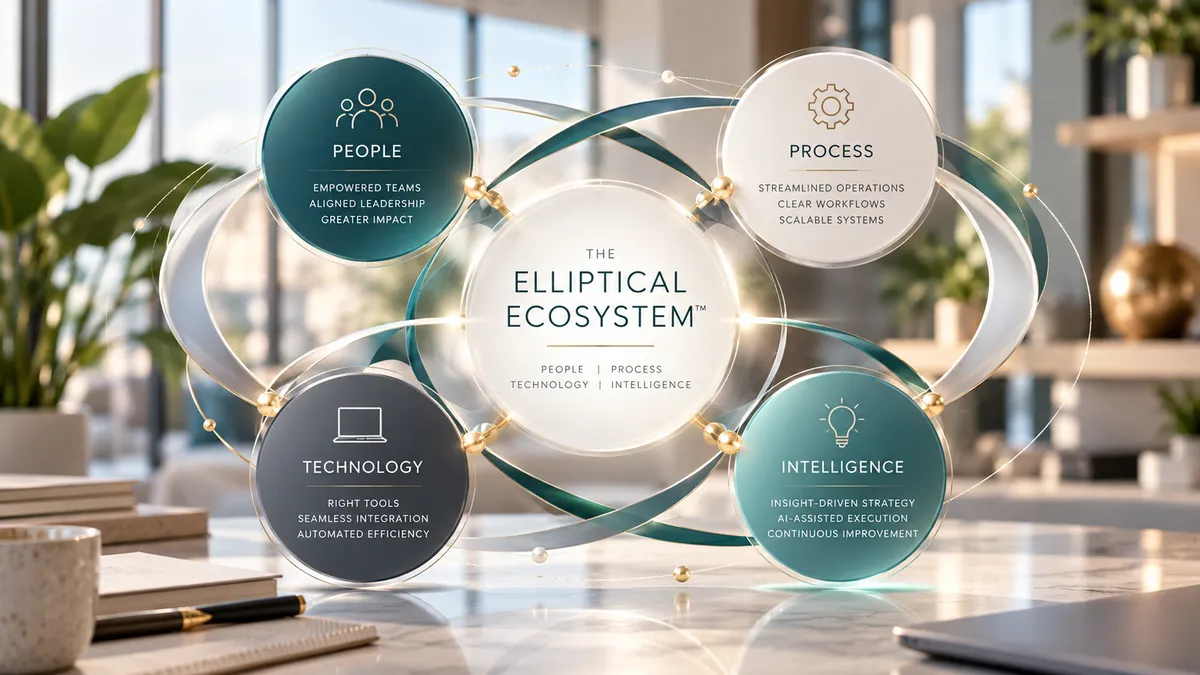
Clarify. Design. Automate. Optimize. Sustain.
WHY SYSTEMS FAIL
Improving the parts does not guarantee the whole will flow.
A business can have talented people, documented processes, powerful software, sophisticated automation, and AI—and still feel harder to run than it should.
Why?
Because those elements may have been improved independently rather than architected as one operating ecosystem.
PEOPLE WITHOUT CLEAR SYSTEMS
Capable people compensate for unclear ownership, weak workflows, missing information, and inconsistent processes.
PROCESS WITHOUT ADOPTION
A process can be beautifully designed and still fail if the people using it do not understand, trust, or sustain it.
TECHNOLOGY WITHOUT ARCHITECTURE
More software can create more complexity when systems do not exchange information or support the way work should move.
AI WITHOUT CONTEXT
AI can accelerate the wrong process just as easily as the right one.
Flow requires alignment—not accumulation.
That is why we do not begin with “What can we automate?”
We begin with: “How should this business actually work?”
THE BE EMPOWERED STANDARD
Measure the burden. Design the Flow.
Before changing the system, we first understand what the organization is carrying today.
We look at:
where leaders remain unnecessary bottlenecks
what work requires too much human effort
where ownership or decisions are unclear
how information moves
where handoffs fail
which tools help and which create friction
what automation is already doing
where AI could genuinely create capacity
what must remain human
Then:
We design from the burden backward—not from the technology forward.
THE BRAND PROMISE
Flow is more than operational efficiency.
Flow is what happens when leaders and teams are freed from operational burden and able to work in their zone of excellence—enabled by connected systems and intelligent automation that help people do their best work, create greater value, and drive sustainable profit.
HUMAN FLOW
People do the work they do best.
Clarity. Capacity. Ownership. Judgment. Creativity. Leadership.
OPERATIONAL FLOW
Work moves with less friction.
Connected workflows. Better handoffs. Clear decisions. Intelligent automation. Useful technology.
ECONOMIC FLOW
Greater capacity becomes greater opportunity for value.
Better utilization. Less waste. Stronger delivery. More operating leverage. Sustainable profit potential.
People flow. Work flows. Value flows.
WHAT WE ARCHITECT
Every business system has four dimensions.
The Elliptical Ecosystem™ evaluates every stage through four interconnected lenses. If one is ignored, the system can still break.
PEOPLE
Who should own, decide, create, communicate, and apply judgment?
We consider:
role clarity
decision authority
human capability
adoption
training
knowledge
leadership dependence
customer relationships
PROCESS
What should happen, when, and why?
We consider:
workflow sequence
handoffs
standardization
exceptions
decision points
inputs and outputs
quality controls
customer experience
TECHNOLOGY
What should enable the work and exchange information?
We consider:
platforms
CRM
project systems
data movement
integrations
system overlap
visibility
technical fit
INTELLIGENCE
Where should human judgment, automation, data, or AI drive the next action?
We consider:
human decisions
rules-based automation
AI assistance
data signals
review points
exceptions
risk
context
The goal is not maximum technology.
It is the right combination of human intelligence and system intelligence.
THE METHOD
Five stages. One connected operating ecosystem.
The Elliptical Ecosystem™ is intentionally iterative. Businesses change. People change. Technology changes. The system must be able to learn, adapt, and continue moving.
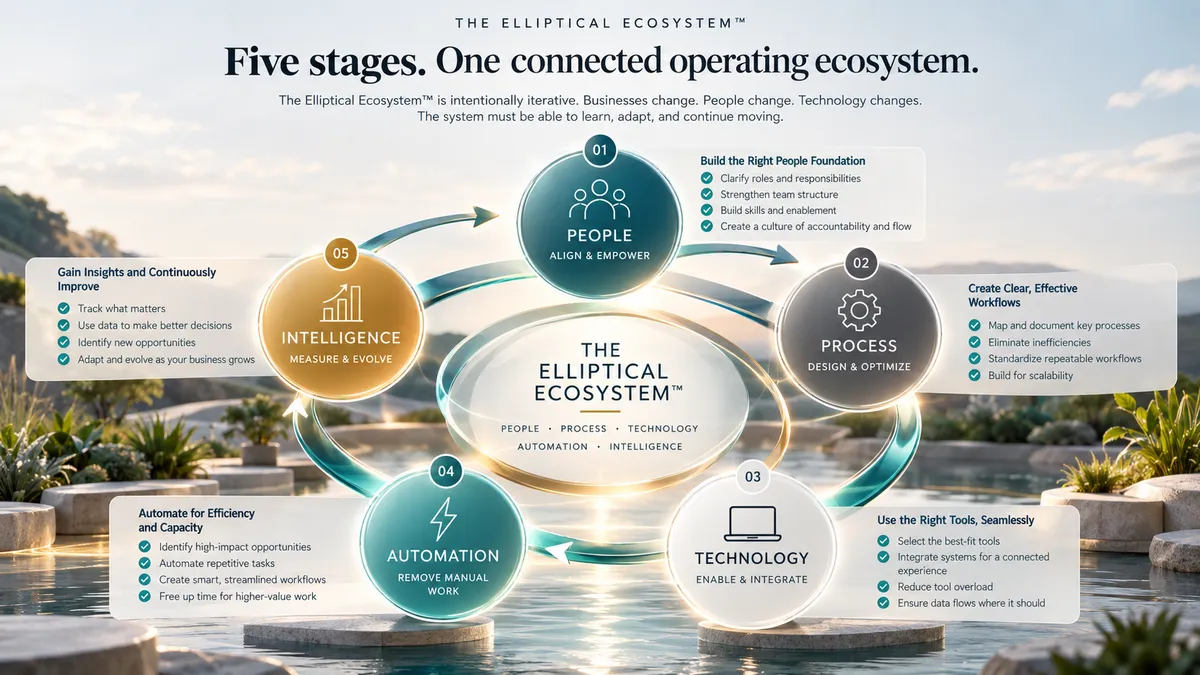
01 — CLARIFY & ALIGN
Get clear before you optimize.
We begin with the business outcome—not the tool.
We identify:
strategic priorities
customer/client value
business objectives
current burden
key roles and decision makers
ownership gaps
current workflows
what success should look like
Core question:
What are we trying to make possible?
Output examples:
Current-state understanding
Priority map
Success measures
Key friction points
Alignment on desired future state
02 — DESIGN & SYSTEMIZE
Build the way work should work.
Before automating, we redesign the flow itself.
We define:
future-state workflows
ownership
handoffs
decision paths
standards
exceptions
information requirements
customer/team experience
Core question:
If we were designing this intentionally today, how should the work move?
Output examples:
Future-state process maps
Responsibility clarity
Workflow architecture
Decision logic
System requirements
03 — AUTOMATE & INTEGRATE
Remove unnecessary burden intelligently.
Technology enters after the work has been clarified and designed.
We determine:
what should stay human
what should become systematic
what should be automated
where AI can amplify capability
which systems need to connect
how information should move
where human review is essential
Core question:
What should people do—and what should the system carry for them?
Output examples:
Automation workflows
System integrations
CRM configuration
AI-assisted processes
Information-routing logic
Human review checkpoints
Automate tasks. Amplify people.
04 — OPTIMIZE & ELEVATE
Make better better.
Implementation is not the finish line.
Once the system is operating, we evaluate:
adoption
actual workflow performance
bottlenecks
exceptions
rework
data quality
automation effectiveness
AI performance
user experience
business impact
Core question:
What is the system teaching us now that it is operating?
Output examples:
Optimization recommendations
Performance adjustments
Automation refinements
AI improvements
Workflow simplification
Reporting/dashboard insight
05 — SUSTAIN & SCALE
Build Flow that can evolve.
A system that only works while the consultant is present is not a successful system.
We strengthen:
process ownership
documentation
training
knowledge transfer
governance
feedback loops
continuous improvement
AI-use guidance
system maintenance
readiness for growth
Core question:
How does the organization sustain Flow as the business changes?
Output examples:
SOPs
Training resources
Governance guidelines
Ownership model
Review cadence
Optimization roadmap
Clarify → Design → Automate → Optimize → Sustain
Then repeat as the organization evolves.
WHY THE NAME MATTERS
Business transformation is not a straight line.
Traditional process diagrams often imply that transformation has a beginning, an end, and a fixed sequence. Real businesses do not operate that way.
The Elliptical Ecosystem™ reflects a different reality:
priorities evolve
customers change
people develop
technology improves
new friction emerges
AI capabilities expand
growth changes the operating environment
So the system must keep circulating through clarity, design, automation, optimization, and sustainment.
Flow is continuous.
The goal is not to build a perfect system once. It is to build an ecosystem capable of continuing to improve.
HOW WE THINK ABOUT AI
The goal is not to automate people out of the business.
It is to automate unnecessary burden out of their way.
HUMAN INTELLIGENCE
People are strongest at:
Judgment
Context
Creativity
Empathy
Leadership
Relationships
Ethics
Discernment
ARTIFICIAL + SYSTEM INTELLIGENCE
Technology is strongest at:
Speed
Repeatability
Information processing
Pattern identification
Routine execution
Data movement
Monitoring
Scale
Flow happens when each does what it does best.
The Elliptical Ecosystem™ intentionally determines where human intelligence must remain central and where systems, automation, and AI can create capacity around it.
FROM METHOD TO MEASURABLE CHANGE
Flow should be observable.
The Elliptical Ecosystem™ is designed to create meaningful change in how people work, how operations perform, and how the business creates value.
We establish relevant human, operational, and economic baselines before implementation so we can evaluate what changes after the system begins to move.
Measure the burden. Design the Flow. Measure what changed.
FROM METHODOLOGY TO ENGAGEMENT
One methodology. Different depths of transformation.
The Elliptical Ecosystem™ powers every core Be Empowered engagement. What changes is not the thinking—it is how much of the operating environment we apply it to.
FLOW FOCUS
One critical area.
FLOW CONNECT
Multiple connected functions.
FLOW BUILD
A broader operating ecosystem.
If you want to compare fit, value, scope, and investment, explore the engagement structure on the How We Help page.
ONE ARCHITECTURE. MANY APPLICATIONS.
The problem changes. The systems thinking doesn’t.
The Elliptical Ecosystem™ is designed to travel across business models because the underlying challenge is often the same: disconnected people, processes, technology, and information create unnecessary burden.



AT EASE PARENT
Family readiness + operational support
A business designed around reducing the mental and operational burden families carry.
The ecosystem brings together education, planning, reminders, routines, information, and support so families can move from reactive coordination toward greater readiness and ease.
What the methodology demonstrates here:
Designing systems around human burden and making complex information easier to act on.
I SEE YOU ROYALTY
Education + commerce + guided experience
An ecosystem where education, products, technology, and customer guidance work together rather than existing as separate touchpoints.
What the methodology demonstrates here:
Connecting content, commerce, customer experience, and technology into one intentional journey.
ELYSIAN GLAM
Luxury commerce + relationship-driven operations
An ecosystem connecting product assurance, customer education, stylist relationships, service workflows, and business support.
What the methodology demonstrates here:
Designing Flow across a business where trust, expertise, customer experience, and operational consistency all matter.
Different businesses.
Different customers.
Different operations.
Same architectural principle: everything moves together.
Questions about the Elliptical Ecosystem™
Is the Elliptical Ecosystem™ an AI framework?
No. It is a business systems architecture methodology. AI may be part of the solution, but only where it creates meaningful value and supports the way the business should operate.
Do all five stages happen in every engagement?
Yes, but the depth varies. A focused engagement may move through the methodology within one workflow, while a broader transformation may apply it across multiple functions or the wider operating ecosystem.
Why not automate first and fix the process later?
Because automation can make a weak process move faster without making it better. We first clarify the intended outcome and redesign the work, then determine where automation and AI belong.
What if the real issue is people or leadership?
Then technology may not be the answer. The People lens helps distinguish system friction from ownership, capability, role clarity, adoption, communication, or leadership issues.
Will we have to replace the tools we already use?
Not necessarily. Existing systems are evaluated based on how well they support the desired operating model. Useful tools should be preserved where they fit.
How do you determine where AI belongs?
We look at where speed, information processing, repeatability, pattern recognition, or assistance can create capacity—while preserving human judgment where context, relationships, ethics, creativity, or leadership matter.
Is this only for founders?
No. The methodology can support founders, executives, leadership teams, and organizations where operational burden is limiting capacity, performance, or growth.
How do I know where to start?
Start with Find Your Flow. It helps identify where burden is accumulating across People, Process, Technology, and Intelligence.
START WITH DIAGNOSIS
Before you redesign the ecosystem, understand what it is carrying.
Find Your Flow helps you identify where operational burden is accumulating across People, Process, Technology, and Intelligence—and which area may deserve attention first.
You’ll gain a clearer view of where friction lives, what people may be carrying unnecessarily, and where better systems could create more capacity.
Your operating system should enable your people—not depend on them to hold it together.
When people, processes, technology, and intelligence are designed to move together, the organization creates more room for clarity, excellence, value, and sustainable growth.
Everything moves together.

Human-Led. AI-Assisted. Designed for Flow.
Business systems architecture that helps leaders and teams reduce operational burden, do their best work, create greater value, and build more sustainable businesses.
Strategy · Systems · Automation · AI
EXPLORE
ENGAGE
LEGAL
Be Empowered Consulting, LLC
9783 E 116th Street #A396 Fishers, IN 46037-2822 United States
+1 833-708-2348
© Copyright 2026. Be Empowered Consulting LLC. All Rights Reserved.